
The information that describes your program - what was booked, what was actually spent, who traveled, against which agreements - is spread across systems that were never designed to talk to each other: TMC and booking feeds, expense, card, traveler profiles, supplier and rate content, and external context like carbon and duty of care.
Each source arrives in its own shape. Even basic ground truth is hard: total managed spend, how many trips, how many room nights at a property, where ancillaries are leaking. Questions that sound simple take days or weeks to answer - if they can be answered confidently at all.
And when an answer does arrive, it comes through a request cycle: a question handed to an analytics team, a report back later - chunky, periodic, one-dimensional. By the time it lands, the moment to act has passed. A report tells you what the data says but rarely tells you what to do about it.
Travel data is uniquely fragmented. Before a program can be analysed, it first has to be reconciled. This is the part many teams do not get through.

Data coherence
Fragmented, inconsistent data becomes one clean, canonical view. Bookings reconciled against expense actuals, normalised across every source, so the numbers can be trusted.

On-demand interpretation
Ask in plain language: "what did we spend on air into Frankfurt last quarter, and how much was out of policy?" for an answer in seconds, not a ticket in a queue.

Insight & recommendation
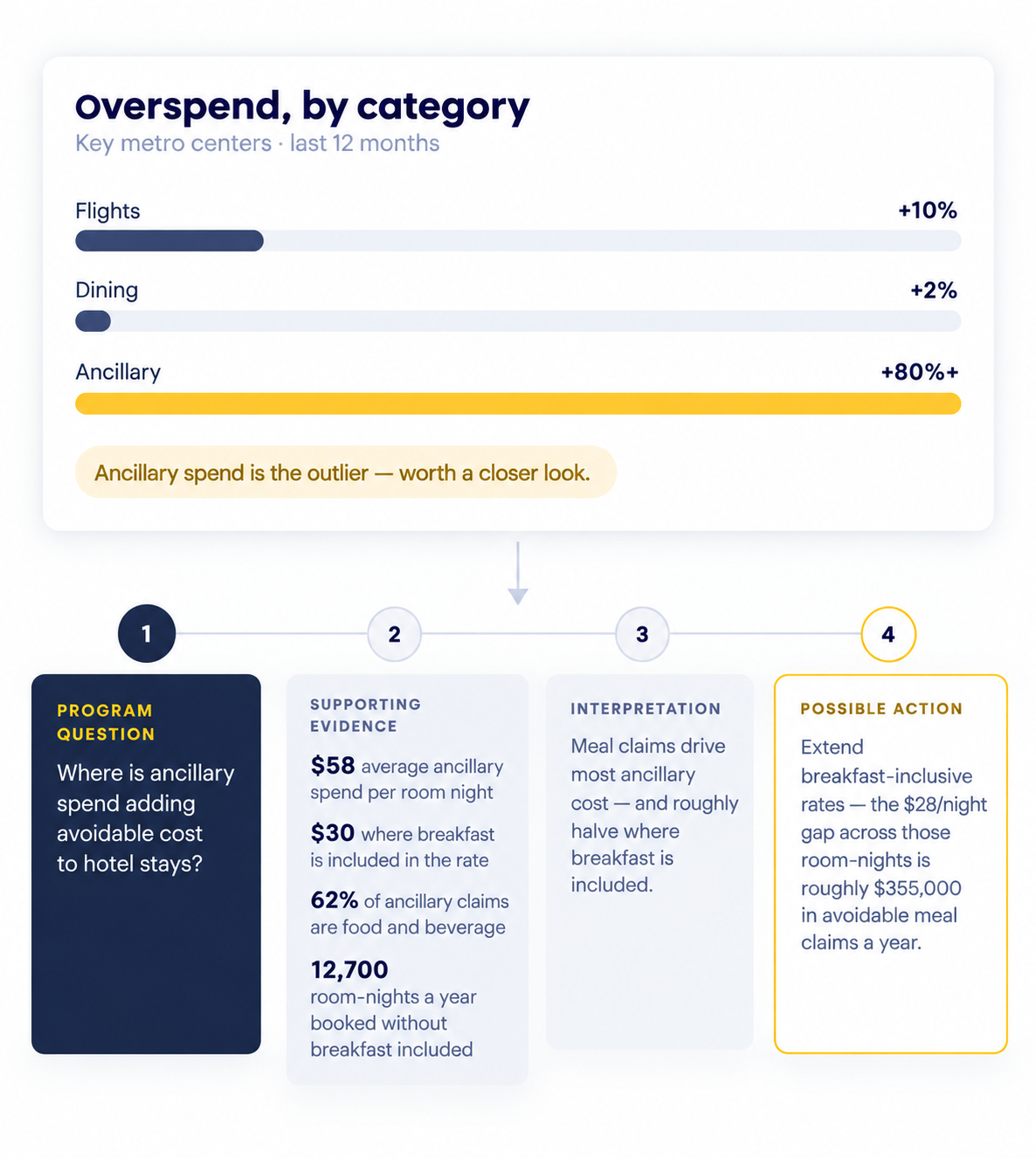
From "what does the data say?" to "what should I do about it?" Tripism surfaces patterns you wouldn't have gone looking for and recommends where to act.

On the roadmap
Agentic automation
The system watches the program, flags an issue before you'd have caught it, and prepares the action - a supplier note, a policy nudge - for your approval.
Fragmented, inconsistent data becomes one clean, canonical view. Bookings reconciled against expense actuals, normalised across every source, so the numbers can be trusted.
The request cycle replaced by a conversation. The team self-serves the questions that used to wait on analysts and spends its time on strategy, not chasing data.
Evidence-grade QBR packs and renewal inputs assembled automatically and kept current. All grounded in spend, compliance, performance and sentiment, not anecdote.
Negotiated-rate capture, ancillary leakage and out-of-policy spend surfaced early. Root causes analysed by route, role or market, which moves sourcing from lowest-rate to best value.
Your program seen not only against itself but against peers. You know whether each number is good, bad, or normal for programs like yours.
Safety, risk and carbon context carried into everyday program decisions, rather than bolted-on after the fact.